Wednesday, September 11, 2013

Warhol, 1962,
Oil on canvas
72 x 52 inches (182.9 x 132.1 cm)
Gift of Seymour H. Knox, Jr., 1963
pop art
Painted by hand with some assistance from stencils, cans are not identical (besides the names)
I picked this painting because I like advertising art and soup. It also reminds me of my kitchen cabinets. Im not OCD but I like organization and I suppose that is why this image appeals to me.  I like his use of everyday boring things as art.

Cafe Terrace at Night by Vincent Van Gogh


This painting was done by artist Vincent Van Gogh mid September 1888 in Arles, France. What i like a lot about this painting is that Van Gogh made a painting of the night very lively and bright. In my opinion i feel most paintings of the night time are darker with some light, but this painting has mostly bright colors making the painting come to life. I think that Van Gogh was trying to give the person viewing the painting the feeling of being there.

"Composition IV"


      This is an abstract painting by Russian artist Wassily Kandinsky entitled "Composition IV". He is known as the "inventor of abstract art". This painting was created in 1911 and its medium is oil on canvas. This piece interested me because of the use of color. It is hard to ignore with its use of so many shades and types of color. I like that this piece is left up to interpretation more than a realist painting.  Kandinsky was not trying to create pictures instead he wanted his art to have emotional and spiritual meaning. To me this painting seems cheerful and bright. I see a rainbow of colors and looking at it makes me somehow happier.

A Wheatfield with Cypresses


Part of his "wheat field' series, Vincent Van Gogh painted this oil on canvas in September of 1889. Van Gogh painted this while he was voluntarily staying at a mental asylum near Arles, France. Along with some others, this painting was inspired by his view of the Les Alpilles mountains outside his window. Shortly after completing this painting Van Gogh committed suicide. I feel as if he started with the lighter colors then started to layer the darker ones on top. I like how the colors blend with each other, the different shades in the clouds make them seem incredibly detailed.

Michelangelo's "Pietá"

Michelangelo's "Pietá," 1498/99-1500, Marble

Located in St. Peter's Basilica in Rome, Michelangelo's "Pietá" emerged in the turn of the 16th century as one of the most influential pieces of sculpture for not only his career, but also for the realm of art. Michelangelo's sculpture depicts the traditional story of Mary holding Jesus after he has been removed from the cross post crucifixion. Prodigious draping from Mary's garb occupies most of the sculpture, but the focal point of the image, though many would immediately assume to be Jesus, seems to instead be Mary herself. Her face contradicts time as it appears to be younger than that of Jesus' as he is 33 at the time of his death. She holds Jesus upon her lap, her knees vividly defined through the draping of her dress.

The significance of this piece struck me while visiting the famous basilica in Rome. Hidden behind  a crowd of art-hungry tourists, the statue remained so peacefully contained in a glass case with a spotlight highlighting it's creamy hue. The sculpture has remained remarkable to me for varied reasons. First, the presence of the sculpture is overwhelming. Regardless of the chaos that flooded the basilica, Michelangelo's sculpture emanated grace and calmness. Most assumably, Michelangelo was attempting to convey the glory of Jesus' death as he unifies humanity and himself with God. Secondly, the image of Mary is remarkable. Not only is she beautiful, but she is also young, angelic, and powerful--most assuredly meant to express her irrevocable purity. Composing Jesus upon her knees provides a triangular structure that's pleasing to the eye. Thirdly, this being his second influential piece sculpted at the age of 23--the first being Bacchus at the age of 19--proves his tremendous talent and stature as one of the greats. In both its detail and precedence, Michelangelo's Pietá takes its place in the history books.

At the Moulin Rouge


HENRI DE TOULOUSE-LAUTREC, At the Moulin Rouge, 1892-1895. Oil on canvas
This painting seems to take place in the Moulin Rouge which is a dance hall the the late 19th century Paris. This Painting is very dark and mysterious to me, especially the women in the corner with the mysterious green face. Its almost as though the face is something you would see in a horror movie. Besides the dark and mysterious theme I like the use of abstract colors throughout the entire painting. I also read in the text book that the artist painted himself in the background, I'm not exactly sure which person he is but I thought that was very creative. 

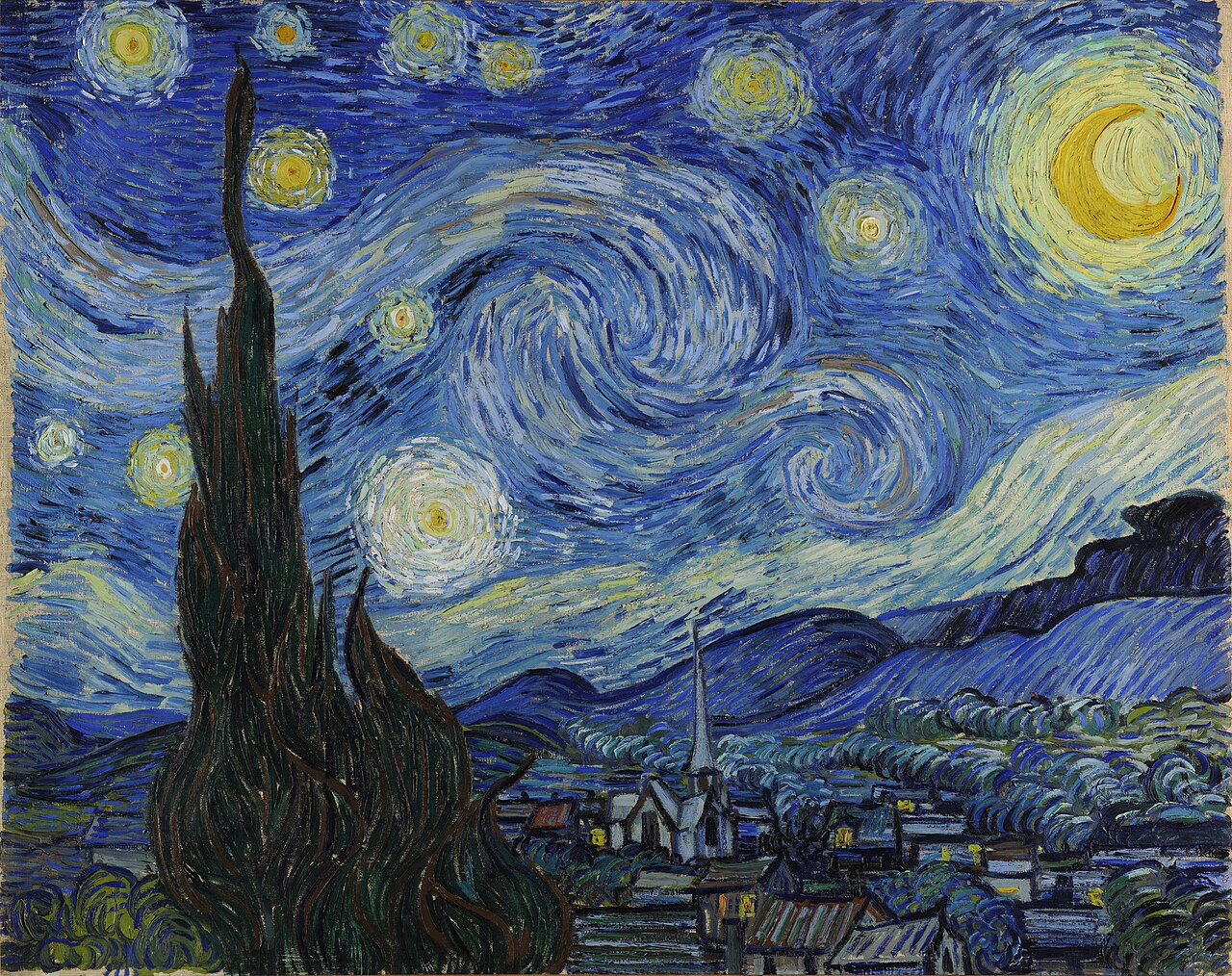
Starry Night


Painted by Vincent Van Gogh in 1889, Starry Night depicts the view outside his window at Saint-Rémy-de-Provence. This piece of art is an oil on canvas and currently resides at the Museum of Modern Art in New York City. It's incredible how Van Gogh painted this during the day and had to refer solely on his memory for detail. I like this painting mainly for its style, it feels blurred how the colors mix but the edges are dark and easy to depict. Ever since I saw this painting as a child, I enjoyed looking at it.